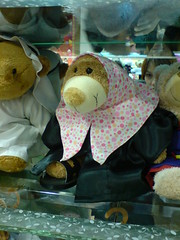
A teddy bear called Muhammad
A pretty cool article about the Muhammad teddybear incident in Sudan, by Arsalan Iftikhar, the contributing editor for Islamica magazine in Washington, D.C.
From the article:
While I was making the global network-television rounds during the Danish cartoon controversy a few years ago, it dawned on me that our human collective was going to continue having international crises every time some backward Muslim knucklehead irrationally reacted to global events somewhere.
Having been asked to explain virtually every kooky action performed by some criminal Muslims worldwide, I saw a new chapter added to the legacy of this sad phenomenon in recent weeks. This time, it was a story about a little teddy bear named Muhammad that lived in the deserts of the African nation of Sudan.
When the incident broke out, I was heartened by the number of commentators on the BBC Have Your Say article, who announced that they were Muslim, and now fully intended to name their next cat Muhammad just for kicks. Of course, there were those who felt very very strongly about it, and thought that the teacher should be lucky that she wasn't getting executed.
Of course, at the heart of it, the story was about culture, not Islam. As you know, Muslims are differents! Some wear scarfs, some belly button rings. Some booze it up, others go vegetarian. Sometimes they're all in the same family (ref: Egypt).
This was my impression of the reactions:
1. Muslims in countries with clear judicial systems and clear recourse to expressing displeasure, seem to feel that if the parents had felt so offended, they should have just asked the teacher to change the name.
2. Muslims in relatively first-world countries, where they were not the underclass, offered to name their next cat Muhammad.
3. Countries with a Muslim majority that had been former British colonies, dryly asked if there would have been a similar outcry if it was a local teacher.
4. Countries with a Muslim majority that had been former British colonies, and still suffering from the aftereffects, thought the world should stay out of this, and the teacher in question should thank her lucky stars that she wasn't executed.
The categories overlap, of course. They're not exact, and definitely not scientific. But to me, it seems to say once again, that the whole conflict had never been about religion. And if that's the case, why are Muslims worldwide on trial? And what's the point of thinking that moderate Muslim leaders will necessarily solve the problem? To Sudan, it's just another case of colonial imperialism.
I'm not saying that moderate Muslim leaders shouldn't bother to speak up. They still have a pull with Sudanese Muslim groups that most world leaders don't have. But at the end of it, the rest of us should stop passing the buck to religious organisations to "take responsibility" for their own, and acknowledge there's more to it. It's too simplistic - and oh yes - fundamentalist.
In the meantime, I agree with Arsalan Iftikhar:
Meanwhile, the world has had yet another chuckle at the expense of every Ali, Akbar and Ahmad out there.
Let me explain: I call this the "Ali, Akbar and Ahmad" phenomenon, which is comparable to the old adage about "Tom, Dick and Harry." To put it in proper context, I would say something like, "I am sick and tired of having to answer for every Ali, Akbar and Ahmad who does some idiotic thing around the world."
But alas, Ali, Akbar and Ahmad always come calling.
If I were given the opportunity, I would fly to the United Kingdom to offer Gillian Gibbons a peace offering. I would express my sadness for her ridiculous ordeal and humbly offer her a teddy bear to put a happy ending on this story.
And that teddy bear's name would be Muhammad.
Read more!
posted by Mezzo @ 6:32 pm
0 comments